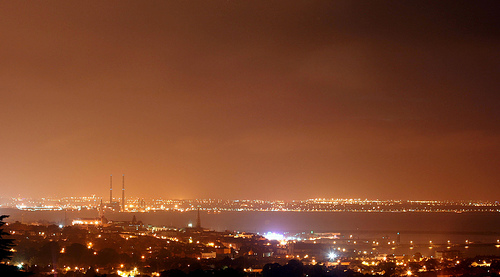
Dark Sky Parks and Dark Sky Reserves – A Comparison

Over the past while I’ve noticed that some confusion has arisen about the distinctions between Dark Sky Parks and Dark Sky Reserves. In preparation for an upcoming meeting I drew up the following 2 pager explaining the key differences. For the impatient, here’s the 2 line difference from Steve Owens:

  • Parks are public land more or less empty of human habitation, and can be of any size.
  • Reserves are large areas centered round a significant dark sky area (the core), with a buffer zone that includes communities stretching a min of 15km on all sides of the core.
Read more

Building an Observatory – Part 1

About 10 years ago I decided to build an observatory. I’m finally getting around to doing it. My reasoning for building it has changed down the years. Initially I wanted to build it in order to have a serious imaging and research setup, now I want it for convenience. I want a setup that I will use – far too many good nights are wasted by not taking the scope out because I don’t have enough time, or it’s just too inconvenient to set up properly. Read more

Hacking a webcam for long exposure astrophotography

I finally got around to hacking a Philips SPC 900 to enable it to take long exposure images suitable for astrophotography. The modifications are fairly well known. The approach I took is a mixture of the http://www.boltonastro.org.uk/Members%5FArea/Projects/spc880conversion.pdf from Bolton Astronomical Society and http://www.yesyes.info/index.php/diy/philips-spc900-webcam-lx-and-ampoff-mod/ .

The circuit between both approaches is roughly the same, I followed the circuit in the former. The modification allows the camera to be switched to a long exposure mode via a switch. The switch can be triggered over a serial port, so I added a USB to serial adaptor and a USB hub (both from ebay) to the unit to allow control from a computer and have just one cable coming from the unit. Read more

Philips SPC900 Mods

A collection of some of the main pages describing the long exposure and amp mods for the SPC900 webcam. http://home.zonnet.nl/m.m.j.meijer/D_I_Y/spc900nc.htm http://www.yesyes.info/index.php/diy/philips-spc900-webcam-lx-and-ampoff-mod/ http://stargazerslounge.com/astro-lounge/114129-pictures-taken-during-some-lx-mono-mods.html http://www.boltonastro.org.uk/Members%5FArea/Projects/spc880conversion.pdf Now just to read through them all, order the bits I need, and do the mod. Simples.   Read more

Light Pollution Sensor Data for December 2010

As part of the 2009 International Year of Astronomy our Colleagues at the Kuffner Sternwarte Observatory in Vienna produced a light meter that could be used to monitor light pollution. More details on the project and the meter are available at lightmeter.astronomy2009.at (use login Guest and IYA2009). There are three stations in Ireland. One in Monasterevin (I’m not sure if it is active), one on the roof of the physics building in Trinity College Dublin, Read more

Partial Light Pollution Sensor Data for November 2010

As part of the 2009 International Year of Astronomy our Colleagues at the Kuffner Sternwarte Observatory in Vienna produced a light meter that could be used to monitor light pollution. More details on the project and the meter are available at lightmeter.astronomy2009.at (use login Guest and IYA2009). There are three stations in Ireland. One in Monasterevin (I’m not sure if it is active), one on the roof of the physics building in Trinity College Dublin, Read more

Partial Light Pollution Sensor Data for October 2010

As part of the 2009 International Year of Astronomy our Colleagues at the Kuffner Sternwarte Observatory in Vienna produced a light meter that could be used to monitor light pollution. More details on the project and the meter are available at lightmeter.astronomy2009.at (use login Guest and IYA2009). There are three stations in Ireland. One in Monasterevin (I’m not sure if it is active), one on the roof of the physics building in Trinity College Dublin, Read more

Partial Light Pollution Sensor Data for September 2010

As part of the 2009 International Year of Astronomy our Colleagues at the Kuffner Sternwarte Observatory in Vienna produced a light meter that could be used to monitor light pollution. More details on the project and the meter are available at  lightmeter.astronomy2009.at (use login Guest and IYA2009). There are three stations in Ireland. One in Monasterevin (I’m not sure if it is active), one on the roof of the physics building in Trinity College Dublin, Read more