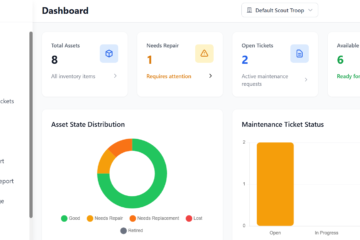
Building with AI: Lessons from Devloping a Django App with Claude

I’ve recently been exploring AI-assisted development, specifically using Claude to build a Django-based inventory management application for scout and youth groups. So how did it go? In a couple of weeks of part-time work, I built and deployed a functional MVP to production: www.armaria.club (app.armaria.club). Here are my key takeaways. These aren’t universal rules, just what worked well for me while developing a real application with AI assistance. I’m also very aware that with the Read more

Installing Jupyter Notebooks on Solaris

pip installing jupyterlab may give you the following error (somewhere in the error output anyway!): The simplest solution I’ve found to this is just to install libzmq. We can pull the latest code from github and install it. I usually install things in /opt but as the pip process will look for libzmq in /usr/local, we’ll install it in there this time. If you do put it somewhere other than /usr/local you might need to Read more

Install scipy on Solaris

When trying to install scipy via pip on Solaris you may encounter this error: There’s a simple way to resolve this but it’s not immediately obvious. BLAS (Basic Linear Algebra Subprograms) and LAPACK (Linear Algebra Something Something…?) are actually provided by the Solaris math and perf libraries, so installing those and setting a couple of environment variables will get scipy and numpy up and running for us on Solaris. Python 3.7 is in more SRU’s. Read more

Django Q function

When querying objects in django the simplest way is to use the filter() query. If we have a set of systems for example and we want to filter out those that have a SPARC architecture we could do: >>> System.objects.filter(architecture=”sparc”) And if we wanted to narrow that down to only sparc machines that use NIS for name resolution we could do: System.objects.filter(architecture=”sparc”).filter(name_resolution=”NIS”) But that is narrowing down the selection. It’s an AND. What were asking Read more

Python: Creating a singleton (to control an Arduino)

A while ago I was writing a tool in python to communicate with a sensor on an Arduino. The idea was to have a class for the Arduino that would hold the connection and handle the reading and writing to the serial port. However that way I needed to have the object maintain the connection and the open COM port (this was on windows), but this meant that I could not have multiple objects. Why? Because you can only have one connection to a COM port. The solution – use a Singleton design pattern. Read more

Python : generating unittests on the fly

When creating python unit tests you need to create a method in a unittest class. The problem however is when you don’t know until the code is running what these tests will be. In my particular case I need to run a series of tests against a number of Solaris packages. But I won’t know what the packages will be in advance. Read more